The fitting room
Cotton Pajamas for Pregnancy and Nursing Access
As an Amazon Associate I earn from qualifying purchases. Purchases take place on Amazon.
A pajama top that opens conveniently and pants that remain comfortable are two separate requirements. During pregnancy and later nursing, the combination you need may change again, so the most useful outfit is not always the one advertised with the largest set of maternity terms. This guide concerns clothing selection and access, not recovery advice or treatment. It looks at what you can establish from actual garment features, what needs to be checked in person and how to choose pieces that may remain useful after the original reason for buying them has changed.
Quick Answer
Choose pregnancy and nursing pajamas by the wardrobe tasks they must handle: changing abdominal room, comfortable waistband placement and convenient top access. A button front can help with opening the garment, but it does not prove a nursing-specific design or suitable fit. Compare top and bottom separately and avoid relying on an arbitrary number of sizes up to cover every stage.
In this guide
- Write the wardrobe brief before choosing a size
- Choose where the waistband should rest
- Evaluate opening access as a small practical task
- Compare the opening before the maternity label
- Run a realistic access and movement rehearsal
- Plan a small rotation that fits your laundry routine
- Choose later reuse without demanding a lifetime fit
Write the wardrobe brief before choosing a size
Begin with the tasks you want the pajamas to handle. You may want pants that rest below the abdomen, a top that opens without being pulled over the head, or a loose shirt that works with separately chosen bottoms. Another wearer may prefer a nightgown to avoid a waistband entirely. These preferences are specific enough to compare; “comfortable maternity pajamas” is too broad to identify the right construction.
List what you already own that still works. If the main problem is the pants, replacing the whole set may be unnecessary. If the top lacks convenient access, separate bottoms could remain useful while a different shirt solves the immediate task. This approach can reduce the number of speculative purchases made for a future fit that is difficult to predict.
Also identify your non-negotiable fabric preference. If you want 100% cotton, a cotton-modal or stretch-poplin description does not meet that requirement without further clarification. If you are open to blends, judge them on their disclosed composition and fit. Neither a maternity label nor a cotton label establishes a health benefit.
Choose where the waistband should rest
Waist placement is a design decision as well as a size decision. Pants intended to rest below the abdomen need enough room through the hips and seat at that position. Pants designed with a specific maternity panel involve a different construction. A regular waistband pulled to an unintended height may move the crotch, shorten effective leg coverage or place tension elsewhere.
Try the position while seated, because a standing fit can conceal pulling at the back or an awkward front band. Notice whether the garment remains arranged without constant adjustment. A drawstring can alter the opening, but it cannot change the rise or create missing seat room. The waistband guide explains these interactions without assigning a universal best band width.
Do not predict that a fixed number of sizes up will suit the entire pregnancy. A larger regular garment can add shoulder, leg and hip volume in places you do not need it. Compare current measurements, the exact garment's intended fit and the specific area requiring room. If a seller provides maternity-specific sizing instructions, establish that they apply to the selected model rather than transferring them from another range.
Evaluate opening access as a small practical task
For a button-front top, check how many buttons must be opened to create the access you want and whether you can reach and operate them comfortably. Buttons can be decorative, partly functional or present only on a short placket, so the word buttoned alone is not enough. An image of the shirt fully opened or a detailed description can clarify the arrangement before purchase.
Consider what happens to the fabric once the top is open. Does a collar or loose panel fall where you do not want it? Can you close the shirt again easily? Does the hem provide the coverage you prefer while seated? Those questions concern usability; they do not require a product to have been marketed as nursing sleepwear.
A pullover with a layered opening or another purpose-built access design can be an alternative, but only when the exact construction is documented. Stretching a regular neckline downward may distort it and may not provide convenient access. Buying a larger neckline to achieve access can also change coverage when you are wearing the top normally.
Compare the opening before the maternity label
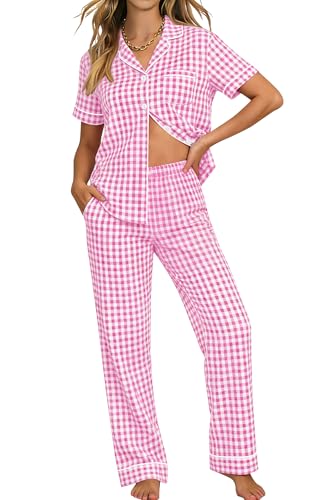
For a short-sleeve shirt opening, SWOMOG's pink-and-white plaid outfit is a concrete example: its title names a button-down top, pants and 100% cotton. That makes its opening format relevant to investigate. The listing title does not establish nursing-specific construction, button dimensions, one-handed operation or maternity sizing. It is a conventional set with a potentially useful feature, not a verified nursing-performance recommendation.
The KCW dark-pink two-piece set is marketed as 100 percent organic cotton and uses postpartum wording. That title does not specify an access system or a maternity waistband. Organic wording is a listing claim and does not establish a checked certification. A shopper should inspect the actual design rather than assume that the postpartum term guarantees the functions needed.
GLOBAL's 100% cotton flannel set names a buttoned top and drawstring waist, offering a different fabric and coverage format to compare. Its description does not confirm an elastic-free waistband or quantify the adjustment range. The choice between it and a short-sleeve set should reflect your garment preferences, room conditions and exact fit, not a claim that one supports recovery better.
The pure-cotton collection can help identify listings explicitly making that fiber claim, while the women's collection provides a wider format comparison. Neither collection should be read as a medical endorsement of the products.
Run a realistic access and movement rehearsal
- Try the top with any ordinary underlayer you expect to wear, because that changes access and bulk.
- Sit comfortably and open the relevant part of the garment without pulling or forcing the fabric.
- Check that sleeves, collars and ties stay arranged in a way you find manageable.
- Close the garment again and assess whether it provides the coverage you want in normal wear.
- Stand and sit once more to see whether the pants and top remain comfortable together.
This is a clothing trial, not a simulation of every feeding situation. Personal preference and circumstances vary. The useful result is a clear observation: the opening is reachable, the buttons are fiddly for you, the top needs a different underlayer, or the pants shift more than you want. Those observations support a decision better than treating a product-category label as sufficient proof.
If you expect to spend time in a particular facility, obtain its actual clothing requirements directly. This guide does not invent hospital policies or promise that a certain pajama format is accepted everywhere. A wardrobe chosen for home use and one chosen around a facility's requirements can have overlapping features without being the same task.
Plan a small rotation that fits your laundry routine
Estimate how quickly you can wash and fully dry a change, then choose an initial quantity that fits that routine. It can be sensible to buy fewer pieces while learning which fit and access arrangement you prefer, especially when your requirements are changing. A large identical multipack commits you to one design before you know whether it works for you.
Use each garment's actual care instructions. The FTC's care-label guidance explains the role of those instructions and warnings. Cotton content does not supply one universal washing temperature or dryer setting, particularly when closures and other components are involved.
Set aside assumptions that “natural” means every stain treatment is suitable or that a hotter wash is automatically the correct routine. The relevant choice is a garment whose supported care method you can carry out. Our pajama rotation guide develops the quantity decision without prescribing an arbitrary number for every household.
Choose later reuse without demanding a lifetime fit
A button-front shirt may remain useful as ordinary sleepwear if you like its cut after access is less important. Separately sized bottoms can be replaced without discarding a top you still enjoy. A coordinated but nonidentical outfit makes that flexibility easier than a design whose value depends entirely on every piece matching.
However, do not sacrifice present usability to an uncertain future fit. A garment that is awkward now is not a good purchase simply because it might work months later. Treat later reuse as a benefit when the current requirements are already met. The same applies to a bigger regular size: it may be a useful loose outfit for some wearers, but it is not a universal substitute for a design intended around different proportions.
If waistbands are the recurring obstacle, compare a cotton nightgown on its own merits, including leg coverage and opening access. There is no requirement to force every wardrobe need into a two-piece pajama set.
Questions about this decision
Can ordinary button-front cotton pajamas work for nursing access?
They can be worth trying when the opening, fit and fastening method suit you. A button-front description alone does not establish a nursing design or convenient one-handed use. Check the actual opening while seated and with the underlayer you intend to wear.
How many sizes should I go up for pregnancy pajamas?
There is no reliable universal number. Larger regular sizes may add unwanted width or length while still placing the waistband poorly. Follow applicable model-specific guidance, compare your current measurements and consider independently sized pieces or a documented maternity design.
Does postpartum in a product title mean it has a special waistband?
No. That wording does not describe a specific construction by itself. Look for the actual panel, elastic, tie or other closure arrangement and its measurements. The KCW listing discussed here uses postpartum wording without establishing those details in its retrieved title.
Final Verdict
Build this pajama choice around changing fit and workable access, keeping the top and bottom as separate decisions. The SWOMOG button-front set, GLOBAL flannel option and KCW postpartum-marketed set provide real listings to examine, with different features and unresolved details. None establishes a recovery benefit or guarantees suitability throughout pregnancy and nursing. Start with the garment task you need solved now, rehearse its access and seated fit, and choose a care routine you can manage. Later reuse is a welcome bonus when it follows naturally from a useful, comfortable design.
Explore the listed examples
As an Amazon Associate I earn from qualifying purchases. Purchases take place on Amazon.
Cotton; construction not statedSWOMOG 100% cotton short-sleeve button set
A short-sleeve button-front cotton outfit with a named pocket.
Check on Amazon flannel
GLOBAL women’s 100% cotton flannel set
A flannel set with both cotton percentage and waist adjustment stated.
Check on Amazon Cotton; construction not stated
KCW 100% organic-labeled cotton set
Someone comparing pure-cotton sets with an organic fiber claim.
Check on AmazonContinue with the relevant guide
Back to The fitting room · Explore cotton pajamas
Sources and editorial method
This is a researched selection guide. We have not performed hands-on wear, washing or laboratory tests on the featured products.