The fitting room
Cotton Pajama Waistbands: Elastic, Drawstrings and Pressure
As an Amazon Associate I earn from qualifying purchases. Purchases take place on Amazon.
Two cotton pajama pants can have similar waist-size charts and feel quite different when seated. One waistband stays in place with little adjustment; another rolls, digs or needs a tight knot. The difference can involve the band itself, but also the shape of the pants below it. Shopping by “elastic waist” or “drawstring” alone misses much of that relationship. This guide works from construction to an ordinary seated check, so you can identify what you want and avoid treating a visible cord as evidence of a waistband feature that the listing never confirms.
Quick Answer
Compare the waistband's actual construction, resting fit and adjustment rather than assuming all cotton pants feel the same. A drawstring may accompany elastic and does not prove an elastic-free garment. Waist tension also interacts with rise, hips and seat room. If you need a particular elastic material excluded, obtain explicit product confirmation; a cotton fabric label does not establish that detail.

In this guide
- Look inside the waistband description
- Four catalog examples with different levels of detail
- Try to identify the force you are feeling
- A seated inspection that separates band from cut
- How to investigate genuinely elastic-free pants
- Use adjustment for fine-tuning, not reconstruction
- Repair decisions for a pair already in the drawer
Look inside the waistband description
An elastic waistband uses an elastic component to gather and hold the opening. That component may sit inside a fabric casing or be attached in another way. A drawstring adjusts the opening by means of a cord or tie. A garment can use both at once, which is common enough that “drawstring pants” should never be translated into “no elastic” without further evidence.
The placement of the cord matters. An exterior knot can be easy to reach but leave bulk at the front. An interior tie may be less visible while requiring you to reach inside the waistband to adjust it. The title or front photograph may not disclose that arrangement. If access and knot position affect your comfort, seek a close view or a specific description.
Also distinguish the waistband casing from the elastic within it. A cotton-covered surface can be what touches your skin even when the hidden elastic uses other materials. The main fabric composition does not establish the composition of every trim. This is especially relevant when a buyer requires confirmation about an excluded material rather than merely preferring a cotton-feeling surface.
Four catalog examples with different levels of detail
Amazon Essentials' men's cotton poplin straight-fit pants explicitly list an elastic waist and drawstring. This is clear evidence of a combined system. It is not an elastic-free option, and the listing title does not tell us the elastic's material, band width or exact resting tension.
Nautica's men's woven 100% cotton sleep pant explicitly mentions an elastic waistband. The title does not establish a drawstring, so a buyer who wants a tie should verify the current product details rather than borrowing that feature from another brand's pants. Its 100% cotton description also should not be extended into a claim about the elastic component.
GLOBAL's women's 100% cotton flannel set names a drawstring waist. That establishes the tie feature but does not establish whether elastic is absent. U2SKIIN's women's tall cotton bottoms use the broader wording “adjustable waist,” leaving the adjustment mechanism unresolved in the listing title. These differences explain why precise questions are more effective than relying on similar catalog wording.
Try to identify the force you are feeling
If the waistband feels firm while standing and remains firm in every position, its resting fit or construction may simply be unsuitable for your preference. If it feels comfortable standing but pulls sharply when seated, look at the seat and rise too. Pants that do not provide enough room below the band can draw it into an uncomfortable position.
If the pants slide despite a tight knot, consider whether the waist position and cut are working together. Tightening further may keep the opening smaller while leaving the same downward pull from the garment. A heavy pocket load can also change how the pants hang during lounging; evaluate sleepwear with the pockets used as you actually intend to use them.
Rolling is another observation rather than a complete diagnosis. It may relate to band width, stiffness, position, surrounding garment tension or how the wearer sits. A wider band is not automatically better, and a narrow one is not automatically worse. Judge the complete garment in use rather than assigning a universal comfort ranking to width alone.
A seated inspection that separates band from cut
- Put the waistband at your preferred resting height without pulling the pants unusually high or low.
- If there is a drawstring, begin with enough adjustment to keep the pants positioned without a forceful knot.
- Sit normally and check whether the band changes position, folds or is pulled downward at the back.
- Stand and observe whether the garment returns comfortably or needs repeated repositioning.
- Inspect the seat and thigh fabric for tension before deciding that a different elastic alone would solve the problem.
This comparison uses ordinary wear, not maximum extension. A waistband that can be pulled far enough to fit over the hips may still feel tighter than you like while resting. Conversely, a band that feels comfortable at rest may not open enough for convenient pull-on access. Those two functions need to work together.
Try the shirt with the pants during the check. A tucked top changes the layer beneath the band; a loose top may catch on a tie or gathered fabric. If you never tuck pajamas in, a fitting experiment that relies on a tucked layer is not a relevant solution for your nightly use.
How to investigate genuinely elastic-free pants
Use the absence of elastic as a question requiring a direct answer. Ask whether the entire waistband is nonelastic, including the back section, and whether adjustment is solely by a functional drawstring or another closure. A smooth front can conceal an elastic back. A decorative bow can resemble a working tie in photographs.
The available descriptions do not verify an elastic-free cotton pajama model for this guide. It would be misleading to nominate the GLOBAL drawstring set or the U2SKIIN adjustable-waist bottoms as one. If that feature is essential, do not purchase until the exact garment construction is confirmed or choose a different clearly documented option.
Similarly, “latex-free” requires explicit evidence about the relevant components. This guide does not infer it from cotton content, a fabric casing, softness language or an organic claim. For the distinction between main fabric and other garment components, see reading a cotton pajama label. A product answer should identify the exact item and variation rather than merely describe a brand's usual practice.
Use adjustment for fine-tuning, not reconstruction
A drawstring is useful when a moderate adjustment helps the opening stay in a preferred position. It is less useful when a substantially oversized pant needs extensive gathering at the waist. That gathering can create bulk without fixing excessive rise, misplaced pockets or long legs. Compare the set-mismatch guide if the waist compromise arose because you sized the entire set for its top.
Do not choose a smaller size only to reduce gathered fabric if the hips or thighs are already restricted. A different waistband arrangement or trouser cut may be the better change. The same measured opening can feel different depending on how the rest of the pant hangs from it.
For adult shoppers who dislike any waistband, a nightgown or sleep shirt changes the garment structure altogether. It is a separate style decision with its own coverage and movement tradeoffs, discussed in the pajamas-versus-nightgown comparison. It should be considered as an option, not as proof that comfortable pants are impossible.
Repair decisions for a pair already in the drawer
A damaged or stretched elastic component may be replaceable if the construction allows access. Whether the elastic is sewn through, enclosed in a casing or integrated into other seams affects the work. Inspect the actual garment or ask a competent repairer. Pulling out stitches without understanding their role can open a seam needed to hold the waistband together.
Replacing elastic also cannot promise to correct the wrong rise or seat shape. Before spending on repair, distinguish a once-comfortable pair whose band deteriorated from a pair that never fit well. For the first, a targeted repair may preserve a useful garment. For the second, different pants may be a more sensible investment. Our pajama repair guide covers how to make that assessment.
Browse the poplin collection for the documented elastic-and-drawstring example and the flannel collection for the named drawstring set. Keep the distinction between stated and unverified features intact as you compare them.
Questions about this decision
Do pajama pants with a drawstring still contain elastic?
They can. Amazon Essentials’ listed men’s poplin pants explicitly include both. Other titles mention a drawstring without describing the rest of the waistband. Obtain a direct construction answer if elastic-free design is a requirement.
Does a cotton-covered waistband prove the elastic is latex-free?
No. A fabric covering and a main-fiber label do not identify every hidden component. Latex-free status requires specific confirmation for the garment’s relevant materials. None of the waistband examples in this guide has that status verified.
Why does loosening the tie not stop the back waistband pulling down?
The pull may come from insufficient seat room or an unsuitable rise rather than the tie itself. Observe the fabric below the waistband while sitting and standing. A different cut can be more useful than repeatedly changing the knot tension.
Final Verdict
Select a waistband by its documented construction and how it behaves as part of the pants. Elastic plus drawstring, elastic alone and an unspecified adjustable waist are different levels of information, not interchangeable descriptions. Use ordinary seated movement to separate band tension from a pulling seat or unsuitable rise. If elastic-free or a particular component exclusion is essential, require an explicit answer for the exact garment; the available titles do not justify that claim. A well-chosen adjustment should make an already suitable pant easier to wear, rather than compensate for a cut that continually works against you.
Explore the listed examples
As an Amazon Associate I earn from qualifying purchases. Purchases take place on Amazon.
poplinAmazon Essentials cotton-poplin straight-fit pants
A woven trouser with named waist adjustment and pockets.
Check on Amazon woven
wovenNautica men’s woven 100% cotton pajama pants
Woven pure-cotton pants instead of a knit or complete set.
Check on Amazon flannel
GLOBAL women’s 100% cotton flannel set
A flannel set with both cotton percentage and waist adjustment stated.
Check on Amazon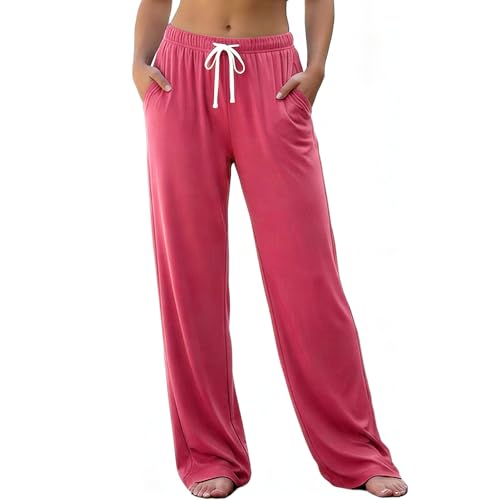 Cotton; construction not stated
U2SKIIN organic-labeled tall cotton pants
Someone starting a search for tall cotton sleep trousers.
Check on AmazonContinue with the relevant guide
Back to The fitting room · Explore cotton pajamas
Sources and editorial method
This is a researched selection guide. We have not performed hands-on wear, washing or laboratory tests on the featured products.