Fabric notes
How to Read a Cotton Pajama Label Without Missing the Blend
As an Amazon Associate I earn from qualifying purchases. Purchases take place on Amazon.
A pajama listing can say cotton in the headline, stretch in a bullet and silky in a photograph caption. Those words answer different questions. The mistake is treating them as interchangeable evidence that the whole set contains only cotton. This guide follows the information on an actual purchase: first the description, then the detailed fiber statement, then the garment that arrives. It also explains why a waistband, lining or second piece can require its own question. You do not need textile expertise to make a sound choice; you need to know which statement proves which part of the claim.
Quick Answer
Read the fiber-content panel for the exact garment and variation, then separate that information from fabric construction, care instructions and marketing language. Cotton in a title does not establish 100% cotton. A cotton-modal set is a blend; a cotton poplin description identifies both a fiber and a construction, but still needs its percentages confirmed.
In this guide
- Start with the number, not the adjective
- Separate four kinds of wording
- Three catalog descriptions, three different levels of certainty
- A two-piece set deserves two-piece attention
- Why a cotton label does not describe every component
- Color selectors can change the item you are reading
- Read the care panel as a separate instruction
- Turn the evidence into a clear purchase decision
Start with the number, not the adjective
Find a statement that pairs fiber names with percentages. A phrase such as cotton feel describes an impression, while cotton blend indicates other fibers are involved without identifying their share. Pure cotton and all cotton are stronger claims, but they still need to match the item selected. Write down the wording exactly before comparing products. Otherwise, it is surprisingly easy to remember a listing as more specific than it was.
The FTC's textile guidance explains that covered products generally disclose fiber percentages by weight, with fibers listed in descending order. It also distinguishes full fiber disclosure from some promotional hangtags. That is why the composition panel carries more useful information than an attractive tag mentioning one material. FTC textile-label guidance.
If a hypothetical label reads 60% cotton and 40% modal, the cotton proportion does not become 100% because cotton appears first. Equally, the presence of another fiber does not establish a poor-quality garment. Your decision is whether that declared mixture meets your preference. Someone seeking cotton specifically should not have to discover the mixture after purchasing.
Separate four kinds of wording
| Type of information | Examples | Question it answers |
|---|---|---|
| Fiber composition | Cotton, polyester, modal and stated percentages | What is the fabric made from? |
| Construction | Jersey, poplin, woven | How is the fabric structured? |
| Surface or appearance | Brushed, silky, linen-like | What texture or look is being described? |
| Garment design | Jogger, capri, button-front | How is the clothing cut or fastened? |
These descriptions can coexist. Cotton can be made into a jersey knit or a woven cloth, and a pajama can be both cotton and brushed. Do not reject a legitimate description because it uses more than one term. Instead, notice when one category is being used to avoid answering another: linen-like never supplies a linen percentage, and a jogger silhouette says nothing about elastane content.
The knit and woven comparison explains the construction decision once composition is settled. Keeping those decisions separate makes your shortlist clearer. You can decide that you want cotton-rich jersey, for example, without pretending that every jersey garment meets the same fiber requirement.
Three catalog descriptions, three different levels of certainty
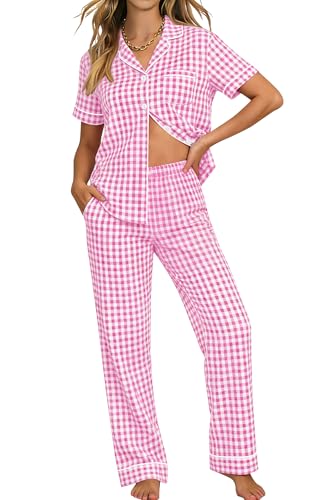
The SWOMOG short-sleeve button-down set represented by ASIN B0G6321MHS explicitly includes 100% cotton in its retrieved title. It also specifies pants, a pocket and a two-piece format. Those are useful stated attributes. That title does not supply fabric weight, a laboratory analysis or the care instructions. A sensible next step is to verify the chosen variation's detailed composition and garment label, rather than adding unstated specifications.
Amazon Essentials' cotton-modal long-sleeve set, ASIN B08XR16MCL, identifies two fibers directly in its name. Its notch collar and elastic-waist pants are also named. We therefore describe it as cotton-modal, not pure cotton. The retrieved title does not give the proportion of each fiber, and guessing a familiar brand formula would be a mistake.
XINJU's muslin set, ASIN B08V1T64CP, combines a 100% cotton statement with double gauze and linen-like wording. The linen reference describes resemblance, not an additional verified fiber. This is a useful example of why reading the entire title matters: pulling out only the word linen would reverse the actual composition claim.
These examples show different information, not a ranking from best to worst. The right choice depends on whether your non-negotiable is fiber purity, a particular construction, or a shape you prefer wearing. Product recommendations should follow that requirement rather than an appealing material adjective.
A two-piece set deserves two-piece attention
When the top and trousers look different, do not assume the headline composition applies equally to both. Look for separate top and bottom specifications or images of each sewn-in label. A plain knit top paired with patterned trousers is a good reason to ask, even when the set is sold as one item. Different appearance does not prove different fibers; it tells you where the description needs to be clear.
The same reasoning applies to an included robe, camisole or third piece. Count the garments in the package and match each to a composition statement. If the description gives one unexplained percentage for a three-piece bundle, request clarification about its scope. A seller's answer should identify the pieces rather than simply repeat that the set is cotton.
Look inside as well as outside. A decorative front, an added lining and a pocket bag may not feel identical against the body. For most buyers, the main cloth is the priority. For someone trying to avoid a particular material wherever it touches skin, the construction details matter just as much as the large percentage printed on the main label.
Why a cotton label does not describe every component
A 100% cotton garment does not imply cotton buttons, cotton zipper teeth or a cotton elastic core. The FTC guidance includes specific treatment of trims and other components. Rather than using the headline percentage as an all-component guarantee, ask separately about the component that matters to you.
For example, an enclosed elastic waistband can place cotton fabric against the skin while containing an unspecified elastic material inside. If you require information about latex, ask the manufacturer that exact question. Cotton content is not evidence of latex-free construction. Likewise, contrast piping can require a separate fiber question even when it occupies little of the garment.
A practical message is: “For this color and size, what are the fibers in the body fabric, waistband covering and any lining?” It is more likely to resolve your concern than “Is this natural?” Keep the request limited to relevant components so that a response can be precise rather than promotional.
Color selectors can change the item you are reading
Choose the intended size and color before recording the composition. Then review the detailed description again. Marketplace pages may group variations together, and a general review can refer to a different option. We do not assume that a brand changes fibers between colors; we simply avoid assuming that it never does.
Check whether a label photograph clearly belongs to the selected product. A photograph showing a different print is weaker evidence for your choice than a product-specific manufacturer statement. If the title and composition panel disagree, treat the conflict as unresolved. Picking whichever statement you like better is not verification.
Save the relevant description with the product identifier when the purchase depends on it. This gives you something concrete to compare with the arriving garment and with the retailer's order details. It also prevents confusion when you have several nearly identical plaid or floral sets open in different browser tabs.
Read the care panel as a separate instruction
Composition tells you what the fabric contains; care instructions tell you how the finished garment is intended to be maintained. They are not substitutes. Two products with the same cotton percentage can specify different drying methods because the finished items differ. Use the actual care directions for washing, ironing and drying decisions.
If routine machine drying is essential in your household, make it a purchasing requirement rather than a problem to solve later. A label that requires flat drying may be completely reasonable for the garment yet unsuitable for your schedule. Our cotton pajama washing guide handles the care process after you have established those instructions.
Before removing labels, check that the item received matches the selected product and that the instructions are legible. If essential information is missing or contradicts the order, contact the retailer through its own process. CottonPajamas.net provides shopping guidance and affiliate links; the seller's current terms govern the transaction.
Turn the evidence into a clear purchase decision
Make three columns in your notes: confirmed, claimed but not independently checked, and unknown. Put exact percentages in the first column only when you have an appropriate product-specific statement. Put broad softness language in the second. Put absent care directions, undocumented trim or an unclear second piece in the third.
You do not need every possible detail to buy pajamas. You do need the detail on which your choice depends. If 100% cotton is essential, an unresolved blend is a reason to keep looking in the pure-cotton collection. If a cotton blend is acceptable, compare its actual benefits and limitations instead of overlooking it because the label is less simple.
Questions about this decision
Does cotton-rich mean the same thing as 100% cotton?
No. Cotton-rich indicates that cotton is a substantial part of a mixture, but the phrase alone does not give a complete percentage breakdown. Look for the named fibers and their amounts. If your goal is to exclude polyester or another fiber, an incomplete description cannot settle that question.
Can a set called cotton pajamas have a modal blend?
Yes. The Amazon Essentials cotton-modal example explicitly identifies that combination. The useful issue is whether the description explains the blend clearly. Do not shorten the product name in your notes until the modal disappears, and do not infer the cotton-to-modal ratio from another item by the brand.
Does linen-like cotton contain linen?
The words linen-like describe resemblance and do not establish linen content. XINJU's retrieved title pairs that wording with 100% cotton and double gauze. A genuine cotton-linen blend needs its own fiber statement. Texture and composition remain separate pieces of information.
Final Verdict
A useful pajama label reduces uncertainty rather than merely adding appealing words. Begin with the selected garment's composition, identify whether the statement covers every piece, and investigate only the components that affect your choice. Then consider construction and care as separate decisions. The clearest product is not automatically the most luxurious one; it is the one you can evaluate honestly. If a key fact remains unresolved, keep that uncertainty visible and choose another item when necessary. A specific cotton preference deserves a specific answer before purchase.
Explore the listed examples
As an Amazon Associate I earn from qualifying purchases. Purchases take place on Amazon.
Cotton; construction not statedSWOMOG 100% cotton short-sleeve button set
A short-sleeve button-front cotton outfit with a named pocket.
Check on Amazon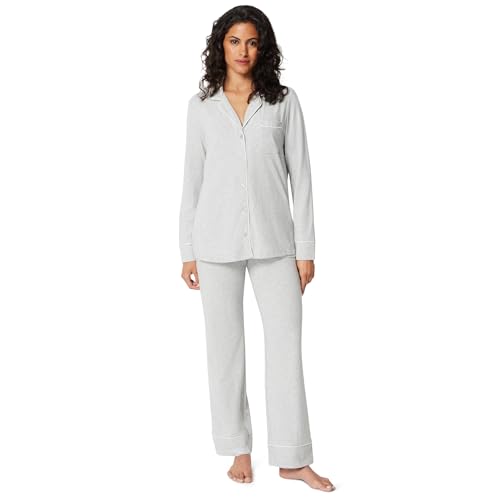 Cotton; construction not stated
Amazon Essentials cotton-modal long-sleeve set
A coordinated long-sleeve outfit when pure cotton is not essential.
Check on Amazon gauze
gauzeXINJU 100% cotton double-gauze set
A textured cotton set for readers investigating double gauze.
Check on AmazonContinue with the relevant guide
Back to Fabric notes · Explore cotton pajamas
Sources and editorial method
This is a researched selection guide. We have not performed hands-on wear, washing or laboratory tests on the featured products.