Fabric notes
Cotton vs. Modal Pajamas: Compare Drape, Blends and Everyday Care
As an Amazon Associate I earn from qualifying purchases. Purchases take place on Amazon.
A cotton-modal pajama can look like a polished shirt set while promising the relaxed feel of loungewear. That combination is appealing, but it raises a more useful question than which fiber is best: how much do you want the fabric to follow your body, and what are you willing to do to maintain it? This guide approaches cotton and modal through those everyday choices. It distinguishes a pure-fiber claim from a blend, explains what to look for in a draped garment, and avoids borrowing manufacturer performance claims for products whose fiber source or construction has not been confirmed.
Quick Answer
Modal and cotton are different fibers, and many pajamas combine them. Compare the exact blend and construction rather than treating modal as a type of cotton. A draping garment may appeal if you like fabric following the body; a more structured cotton style may suit a different preference. Neither the fiber name nor softness wording establishes the actual fit or care method.
In this guide
- First, place modal in the right material category
- Start with the way fabric hangs
- The Amazon Essentials cotton-modal set: what is actually known
- Separate the modal blend from the way it is constructed
- Blend percentages change the question
- Wet handling: avoid borrowing another garment's instructions
- Separate body drape from shape retention
- Choose using your tolerance for contact and maintenance
First, place modal in the right material category
Modal is a manufactured cellulosic fiber, not a cotton variety. Lenzing's TENCEL brand describes its modal fibers as wood-derived; that brand-specific information does not establish the supplier of every modal pajama. TENCEL Modal, generic modal and a cotton-modal blend should remain distinct descriptions. TENCEL fiber information.
The distinction matters because shoppers sometimes read cotton-modal as a special kind of pure cotton. It is a combination of named fibers. To understand the garment, you need its percentages as well as whether it is knitted or woven. A familiar feel cannot tell you the ratio, and a brand name cannot supply a missing composition panel.
If excluding synthetic or regenerated fibers is your goal, be precise about that preference. Modal does not meet a requirement for 100% cotton. If instead you are open to a blend that feels comfortable, the presence of modal is a reason to investigate the fabric rather than to dismiss it automatically.
Start with the way fabric hangs
Look at a garment hanging freely, then at the same style worn without being pulled tight. Does the fabric collapse into soft folds, or does it hold a more defined outline? For pajamas, this affects how the top lies across the chest, how trouser fabric gathers on a chair and how visible the body's shape feels through the clothing.
Modal is often marketed for a soft, flowing effect, but you still need to judge the actual garment. A manufacturer may combine it with cotton and other fibers, choose a heavier cloth, or cut the set more closely. Do not transfer an impression from a modal T-shirt to a different pajama solely because the fiber name appears in both.
Cotton also offers varied drape. Jersey, poplin and flannel are not interchangeable experiences. If you want a more structured comparison, use a known woven cotton item as one reference and a clearly identified cotton-modal garment as another. That gives the question a practical shape without pretending that either represents every possible fabric in its category.
The Amazon Essentials cotton-modal set: what is actually known
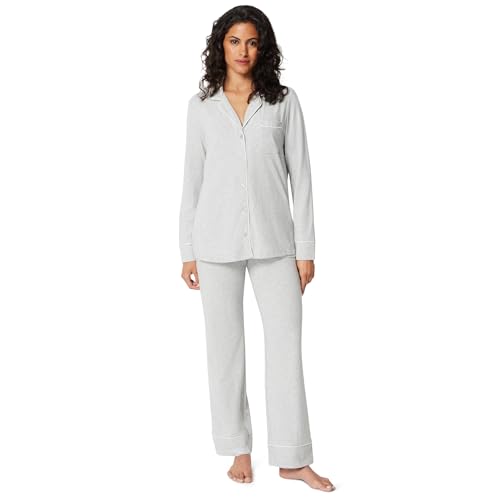
The retrieved description for Amazon Essentials' women's set, ASIN B08XR16MCL, identifies cotton-modal fabric, a long-sleeve notch-collar shirt and full-length elastic-waist pajama pants. Those details make it a relevant starting point for this comparison. They do not give the blend percentages, fabric weight, stretch recovery or manufacturer drying directions.
The collar and full-length format matter independently of the blend. Someone who dislikes fabric around the neck may prefer another style even if they enjoy the body fabric. Someone wanting complete leg coverage may value the trousers. Keep those design preferences separate from an assumption that modal itself explains every feature of the set.
For an explicit cotton alternative, Veseacky's navy long-sleeve set, ASIN B0DGQ97W5N, states 100% cotton. Its title does not establish the same construction, dimensions or laundering method as the Amazon Essentials set. The comparison therefore begins with composition and format; it is not a documented performance contest.
You can inspect the cotton-modal product page and the Veseacky cotton set with those limits in mind. Their role here is to make the decision concrete, not to imply that either was worn or tested by our editorial team.
Separate the modal blend from the way it is constructed
A useful comparison changes one major textile variable at a time. If you compare a cotton-modal jersey with a pure-cotton woven, both composition and construction have changed. You may prefer one garment, but the result cannot tell you which difference caused that preference. Write down both variables before attributing a flowing feel to modal alone.
| Comparison you make | What changes | What it can help decide |
|---|---|---|
| Two jersey garments with different declared fibers | Composition, with a similar construction category | Which actual cloth you prefer within a familiar knit direction |
| Cotton-modal jersey against cotton poplin | Fiber mixture and construction | Which whole fabric direction suits you, without isolating a fiber effect |
| Two cotton-modal styles with different hems | Garment coverage and cut | Whether the style difference matters more than a shared blend name |
Amazon Essentials' jersey capri set, ASIN B09SZ55T54, names cotton-modal knit jersey and a wide-leg format. The full-length notch-collar set names cotton-modal but does not establish its construction in the retrieved title. Their shared fiber wording therefore does not prove identical cloth. Nor should the capri set's shorter coverage be described as a modal advantage.
Keep broad fabric drape separate from pressure at edges. A yielding body fabric can still meet a firm waistband or a structured collar. If seams and contact points are your main concern, the skin-comfort guide owns that inspection. Here the task is to understand which part of a cotton-modal comparison is actually about the mixture, which is construction, and which is the garment's shape.
Blend percentages change the question
A hypothetical 90% cotton garment with 10% modal is not the same composition as one with the proportions reversed. These numbers are examples, not specifications for the linked set. They show why cotton-modal without a ratio is incomplete when you are trying to understand which fiber predominates.
Look for every named fiber, not just the two promoted in the headline. Added elastane, if present, creates another consideration around fit and recovery. Its existence must be documented; a stretchy-looking photograph is not proof. Similarly, a garment can have some give from its knit construction without an added stretch fiber.
Once you have the full statement, ask whether the mixture meets your priority. If you simply want something pleasant to wear, the blend can remain a candidate. If you require all cotton, move to the pure-cotton collection rather than trying to reinterpret a blend as equivalent.
Wet handling: avoid borrowing another garment's instructions
Do not treat all rayon-family fabrics as having identical care, and do not assume a cotton-modal pajama can use the same method as a sturdy cotton towel. The manufacturer has to account for the whole item, including construction, dyes and trims. The specific care panel is the relevant instruction for the garment you own.
The FTC's care-label guidance explains why apparel carries care instructions and warnings. For shoppers, the useful consequence is simple: obtain that information before buying when a particular washing or drying method is essential. A fiber discussion cannot substitute for missing garment directions. FTC care-label guidance.
When laundering a garment that requires gentle handling, support the fabric instead of pulling a wet piece by one small area. Follow its reshaping and drying directions. This is about avoiding unnecessary strain during handling, not a claim that the linked modal blend is unusually fragile or requires a specific unverified method.
If you need to wash and dry sleepwear quickly every few days, compare that requirement with the actual instructions. A garment that needs more attention may still be a good choice for someone else. The care routine should be part of the purchase, not an unwelcome surprise after the first wash.
Separate body drape from shape retention
A fabric that flows smoothly today does not automatically retain its shape indefinitely. Conversely, a structured cotton garment is not guaranteed to remain dimensionally unchanged. Ask whether the manufacturer supplies useful information about sizing after laundering, and avoid making a lifetime prediction from a soft hand or a premium-sounding fiber name.
For an owned garment, compare its shape when freshly laundered with its shape after ordinary wear. If knees or elbows become more prominent, note where and under what conditions. That observation is more useful than assuming every change results from one fiber in the mixture.
The stretch and shape-retention guide handles that problem directly. Here the purchasing task is to avoid confusing softness, stretch and recovery. They may be related in a particular fabric, but they are not three names for the same property.
Choose using your tolerance for contact and maintenance
A cotton-modal garment deserves consideration if you enjoy its actual drape, accept the declared blend and can follow its care routine. A cotton alternative may be the clearer choice if fiber purity is important or if a particular cotton construction already works well for you. There is no need to replace a known preference with an abstract ranking.
If you are uncertain, compare an existing garment you love with the candidate's features. Note neckline, sleeve width, leg shape and broad fabric feel. That gives you a reference grounded in your own use. It is more informative than an online claim that a material is ideal for every sleeper.
Finish by checking the fabric topic hub for the distinction you still need to resolve. If the remaining uncertainty is the fiber percentage, ask the seller. If it is body contact, prioritize fit information. If it is maintenance, obtain the care panel. Each question has a different source of evidence.
Questions about this decision
Is modal a premium grade of cotton?
No. Modal is a different fiber, and a cotton-modal description names a blend. Premium cotton terms such as Pima answer another question. A garment can be comfortable without being pure cotton, but the distinction should remain clear throughout the buying decision.
Does every modal pajama use TENCEL fibers?
No such assumption is justified. TENCEL is a specific fiber brand, and its claims should not be transferred to a generic modal item. Look for product-level identification if that sourcing matters. The retrieved Amazon Essentials title does not establish a TENCEL source.
Will choosing modal solve a tight waistband?
Not necessarily. Waistband construction and garment sizing can create pressure regardless of the main cloth. Check the elastic, rise and dimensions first. A different blend may change the broad fabric feel while leaving the same fit problem unresolved.
Final Verdict
A cotton-modal pajama is best evaluated as a complete garment with a declared mixture, not as upgraded cotton. Let drape, body contact and a workable care routine decide whether it belongs in your wardrobe. The Amazon Essentials example offers a concrete blend to investigate, while an explicit cotton set provides a different composition baseline. Neither can be ranked honestly without the missing product details. Choose the option that meets your own contact and maintenance preferences, and keep softness claims from standing in for fit, percentages or evidence.
Explore the listed examples
As an Amazon Associate I earn from qualifying purchases. Purchases take place on Amazon.
Cotton; construction not statedAmazon Essentials cotton-modal long-sleeve set
A coordinated long-sleeve outfit when pure cotton is not essential.
Check on Amazon Cotton; construction not stated
Veseacky 100% cotton long-sleeve set
A simple two-piece option where fiber percentage is the first filter.
Check on Amazon jersey
Amazon Essentials cotton-modal jersey capri set
A jersey capri outfit when a cotton blend fits your preferences.
Check on AmazonContinue with the relevant guide
Back to Fabric notes · Explore cotton pajamas
Sources and editorial method
This is a researched selection guide. We have not performed hands-on wear, washing or laboratory tests on the featured products.