Everyday decisions
Cotton Pajamas for Skin Comfort: Seams, Tags and Contact Points
As an Amazon Associate I earn from qualifying purchases. Purchases take place on Amazon.
A pajama shirt can feel pleasant across the sleeve and still have one label edge that dominates the whole experience. That is why selecting clothing for skin comfort is less about awarding a fiber a reassuring adjective and more about locating contact points. Your priorities may be a neckline without a scratchy edge, a waist that does not fold into a narrow ridge, or seams that stay away from a pressure-sensitive position. The following inspection method is intended for ordinary clothing preferences. It cannot certify a garment as hypoallergenic or determine whether it is appropriate for a diagnosed condition.
Quick Answer
Choose for the parts of the garment that touch and press against you: seam allowances, label edges, embroidery backing, buttons, cuffs and the waistband. Cotton content alone cannot establish skin comfort or allergy suitability. Identify where a current outfit bothers you, then inspect that same area on a replacement. Keep texture preferences separate from medical conditions and treatment decisions.
In this guide
- Draw a contact map from an outfit you own
- Inspect the inside before judging the outside
- Pressure can masquerade as rough fabric
- What the current product descriptions can establish
- Keep washing preferences visible in the decision
- Use a position-based try-on sequence
- Do not pay for reassurance that has no defined meaning
Draw a contact map from an outfit you own
Start with the garment that gives you the clearest information. Put it on briefly in an ordinary position and identify the location of the annoyance: inside the neck, beneath an arm, along a side seam, around the waist, or behind the knee. Note whether it happens immediately, only when lying down, or after the garment shifts. This helps distinguish a rough component from pressure created by an otherwise smooth component.
Describe the sensation in clothing terms rather than diagnosing it. A stiff label edge, a folded waistband and a lumpy seam intersection are observations you can use while shopping. Simply writing sensitive skin leaves the important detail unresolved. If discomfort is persistent, involves a rash or raises a medical concern, a clothing checklist should not replace appropriate professional advice. The purpose here is to remove avoidable garment annoyances, not to explain their biological cause.
Inspect the inside before judging the outside
Turn the top inside out. Follow the seam from the sleeve opening toward the underarm and down the side. Pay particular attention where several pieces meet, because the combined thickness may be more noticeable than a single seam. A clean-looking outer surface says little about that intersection. Photographs showing only the front of a model do not reveal whether the interior finish suits your preferences.
Next, look behind decorative elements. An embroidered motif may have backing; a pocket attachment may introduce stitching across an area that rests against your body. Piping can create a ridge near the neckline or placket. None of these features is automatically uncomfortable, but each adds something distinct to inspect. Avoid rejecting all decoration by default when the real issue may be only one poorly placed or unusually substantial detail.
Finally, examine labels as physical objects. A printed label and a sewn label present different contact surfaces, but neither format guarantees that you will like it. If you are considering removing a label after keeping the garment, preserve a clear record of the fiber and care information first. Do not assume cutting a label close to the seam will leave a smooth edge; a short stiff remnant can still be noticeable.
Pressure can masquerade as rough fabric
A waistband that feels acceptable while standing can become distracting when seated. Check whether it stays broad or rolls into a cordlike ridge. Notice whether a drawstring knot sits beneath your preferred resting position. These are reasons to investigate waistband design, rather than immediately concluding that the cotton itself is unsuitable. Our waistband guide covers that construction decision in more detail.
Sleeve and leg openings deserve the same attention. A cuff can keep material in place but may be unwanted if you dislike a concentrated contact area. An open hem can avoid that pressure while introducing more moving fabric. Try bending the limb and resting it against a surface. The better option is whichever arrangement avoids your particular annoyance; a general claim that cuffs are softer or healthier would not answer the question.
What the current product descriptions can establish
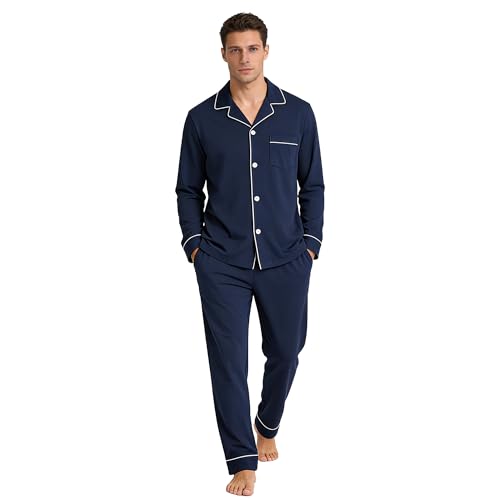
U2SKIIN B08P6MS568 is listed as a men's 100% cotton button-down pajama set. That tells you a fiber claim and closure type to investigate. It does not tell you the inside seam finish, label format, button-back contact or whether a particular finish has been applied. If your priority is a smooth front while lying on your stomach, the buttons deserve closer inspection even though the main cloth is described as cotton.
PajamaGram B071HJ6V11 is described as a cotton jersey pajama set. Jersey makes it relevant when you want to examine a knit option, but the title cannot resolve the exact feeling of the side seams or the softness of the waistband enclosure. Cotton jersey is not a universal pass for contact comfort. Ask for the internal details that match your contact map, rather than assuming the fabric category settles everything.
Ekouaer B0G3FNW7ZY uses 100% cotton and jogger-set wording. The jogger format invites a closer look at the lower-leg opening when ankle contact matters to you. We do not have grounds to describe that opening's precise pressure or its seam construction from the title. A product can therefore be a relevant candidate without being a verified solution to the specific thing you dislike in an existing pair.
Keep washing preferences visible in the decision
An outfit's care requirements may conflict with the routine you already use. Look for the actual washing and drying instructions before you decide that a garment is convenient. The FTC care-label guidance explains that care information belongs to the garment and its components. Do not replace those instructions with an assumption that all cotton can be treated identically, especially when the top includes trim or mixed materials.
If a familiar pair feels different after washing, that is a separate troubleshooting task. Review whether the wash process changed before purchasing a whole replacement wardrobe. Our guide to stiffness after washing addresses possible laundry-related explanations. This page does not prescribe detergents as medical treatment or promise that extra rinsing will resolve every uncomfortable sensation. Keep the observation specific and avoid adding multiple new products at once merely to chase a softness claim.
Use a position-based try-on sequence
Keep the comparison focused if you have several candidate garments. Assess the same contact location on each before moving to the next issue. Otherwise, an attractive fabric may distract you from the neckline detail that prompted the search. A simple note such as seam sits farther forward when seated preserves the useful observation without assigning a sweeping comfort grade to the whole brand.
First, stand and let the outfit settle naturally. Do not keep pulling the shirt or waistband into its most flattering position. Next, sit with your back supported and arms relaxed. Then reach across your torso, bend a knee and briefly adopt your usual resting position. You are looking for where the garment ends up, because a seam that begins away from a contact point may migrate onto it.
Compare only the locations you originally identified. If the old problem was a neck label, does the new garment introduce piping at the same spot? If it was a tight underarm intersection, is there enough room to reach without that seam pressing into you? This makes the assessment more useful than declaring the entire outfit soft after brushing your hand over the chest panel. A few concrete observations are easier to remember when comparing alternatives.
Do not pay for reassurance that has no defined meaning
Terms such as gentle, natural and skin-friendly may communicate a seller's intention, but they do not specify seam structure or establish that an individual will tolerate a garment. Likewise, an organic cotton claim answers a different question from the feel of the finished label, elastic casing or embroidery. If a certification matters to you, verify the named scheme and exact product claim through the relevant evidence rather than treating a reassuring word as comprehensive proof.
It is reasonable to reject a listing that cannot answer the question most important to you. If internal labeling is the decisive issue and no view or description addresses it, the remaining uncertainty has a real cost. A simpler garment with visible construction may be easier to assess than a more elaborate one with stronger adjectives. Browse the pure-cotton collection for composition-focused candidates, then carry out the contact checks independently.
Questions about this decision
Does 100% cotton mean the waistband and every trim are cotton?
Do not infer the composition of every component from a main-fabric claim. Elastic, thread, buttons, decoration and other parts need their own evidence when they matter to your requirements. In particular, a cotton title does not establish latex-free status or eliminate the possibility of a bothersome trim.
Is tagless sleepwear always more comfortable?
It removes a sewn label as one possible contact feature, but the printed area, nearby seam or neckline binding may still matter. Inspect the complete location. Tagless wording is useful when a sewn label is your known problem; it is not a guarantee about the whole garment.
Should I buy a size larger to avoid irritating seams?
A different cut may help more than enlarging every measurement. Extra fabric can move seams or create new folds. Use a position-based adult try-on and compare the troublesome area. This is not advice to size up snug-fit children’s sleepwear, which has separate labeling requirements.
Final Verdict
Make the troublesome contact point the center of your next purchase. An interior photograph, a comfortable seam intersection or a waistband that stays flat can be more relevant than a broad softness claim. The listed cotton and jersey examples give you candidates to inspect, not assurances about skin health. Keep composition, tactile preference and medical concerns as separate questions. When you can explain exactly why a previous garment bothered you, you can ask a seller a much better question and avoid replacing one irritating detail with another hidden beneath attractive fabric.
Explore the listed examples
As an Amazon Associate I earn from qualifying purchases. Purchases take place on Amazon.
Cotton; construction not statedU2SKIIN men’s 100% cotton button-down set
A complete button-down cotton outfit for men.
Check on Amazon jersey
PajamaGram navy cotton jersey set
A jersey set for readers who want knit construction identified.
Check on Amazon Cotton; construction not stated
Ekouaer 100% cotton jogger pajama set
A matching outfit for someone specifically seeking jogger bottoms.
Check on AmazonContinue with the relevant guide
Back to Everyday decisions · Explore cotton pajamas
Sources and editorial method
This is a researched selection guide. We have not performed hands-on wear, washing or laboratory tests on the featured products.