The fitting room
Tall Cotton Pajamas: Check Inseam, Sleeves and Torso Separately
As an Amazon Associate I earn from qualifying purchases. Purchases take place on Amazon.
Two people of the same height can have different pajama problems. One keeps finding exposed ankles but has no trouble with shirt length. The other gets adequate leg coverage yet a top that rises above the waistband whenever they reach. A single “tall” filter can conceal that distinction. Your starting point should be the location of the missing length, followed by measurements that describe it. This guide covers adult women and men together because the measuring logic is shared, while keeping each product's actual cut and chart separate.
Quick Answer
Tall cotton pajamas need enough length in the places your proportions require. An advertised long inseam does not establish long sleeves or a longer torso, and buying a wider size may not add useful length. Compare an exact size chart with a comfortable garment, check seated coverage and consider separates when your upper and lower body need different length arrangements.
In this guide
- Choose the type of length problem you are solving
- What a tall label can and cannot tell you
- Use a chart example to understand the comparison
- A measurement worksheet for a longer silhouette
- Watch what happens after the wearer sits down
- Plan for care without guessing shrinkage
- Build a set around the hardest dimension
Choose the type of length problem you are solving
Start with the pajamas that fall short. If the waistband sits correctly and the crotch feels comfortable but the hem finishes higher than you want, inseam is the most obvious comparison. If moving the waistband to your preferred position pulls the crotch upward, rise is involved too. A longer leg attached to the wrong rise may still feel wrong when you sit.
For tops, distinguish a short sleeve from a short body. Sleeves can finish above the wrist while the torso stays covered, or the opposite can happen. Shoulder width also matters: an overly wide shoulder seam may create apparent sleeve length without providing the intended fit. Write down these separate issues rather than describing the entire set as too small.
A useful note might read “needs more leg length, current rise works, top length fine” or “long torso and sleeves needed; regular pants are adequate.” The first suggests tall bottoms with an independently chosen top. The second warns against buying a whole tall set simply because it appears more convenient.
What a tall label can and cannot tell you
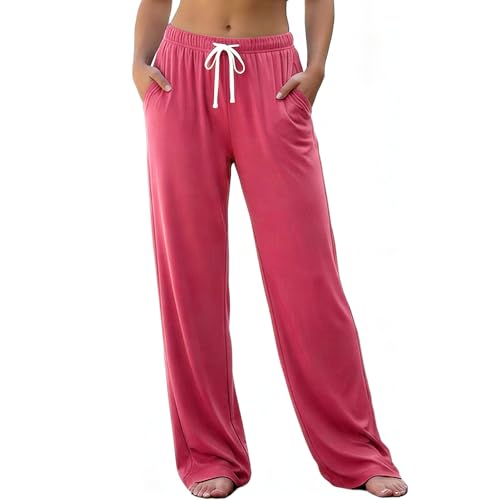
The catalog includes U2SKIIN women's organic cotton pajama bottoms described as tall, loose fitting, pocketed and adjustable at the waist. This is an actual tall-marketed option to investigate. The listing title does not provide the inseam, front or back rise, overall length or adjustment construction. “Tall” establishes the advertised category, not a verified measurement that can be compared with your own pants.
Its organic wording is also a listing claim, not a certification assessment. If cotton composition or certification is essential, verify the selected variation's supporting details separately. None of those fabric claims establishes that the rise is suitable for your proportions. Length, fiber and waistband are different parts of the decision even when they appear together in a title.
The models discussed here do not provide enough documented length information for a longest-pair ranking. Products such as Nautica's men's woven cotton pants give you a separates format, but their retrieved descriptions do not publish long-inseam measurements. A useful guide should identify that missing evidence rather than turn full-length marketing into an unsupported tall recommendation.
Use a chart example to understand the comparison
On its published women's sizing chart, PajamaGram distinguishes a 33-inch tall inseam from a 31-inch regular inseam. That difference illustrates how a brand can add length independently of the main size label. It does not mean the navy cotton jersey set in our Amazon catalog currently offers a tall variation, nor that 33 inches is the right length for every taller wearer.
Take your own preferred inseam to the selected product's current chart. If a listing shows only an overall trouser length, do not treat that as an interchangeable number. Overall length includes the section above the crotch; inseam does not. Ask for both when the rise has been a recurring problem.
A general men's chart and a women's chart can also organize their rows differently. Do not transfer an inseam or body range between departments because the letter size is the same. The exact model's dimensions and the wearer's preferred fit decide suitability. The department label is a catalog organization choice, not a substitute for that comparison.
A measurement worksheet for a longer silhouette
| Record from a comfortable garment | Why the second measurement matters |
|---|---|
| Inseam plus rise | Leg coverage depends on where the crotch and waistband sit |
| Sleeve length plus shoulder position | A displaced shoulder can disguise an unsuitable sleeve arrangement |
| Shirt body length plus hem width | A narrow lower edge may ride upward despite adequate length |
| Hip and thigh widths plus seated fit | Tension can pull fabric upward and mimic a length-only problem |
Use the same start and end points as the chart whenever possible. Some sleeve measurements start at the shoulder seam; others use a point near the neck or center back. A larger number obtained by a different route does not necessarily describe a longer sleeve. Photographing your tape placement helps prevent that mismatch when comparing two listings later.
If no current pair has the right length, identify what works and record the specific shortfall as your own preference. For example, a hem that ends above your chosen ankle point can be compared with another garment you own. Do not add an arbitrary amount merely because a guide says tall people need it. Your intended sleeping and lounging coverage is the relevant endpoint.
Watch what happens after the wearer sits down
Standing photographs flatter the appearance of marginal length. Sit on a chair with knees bent and check whether the hem moves to a position you still like. Reach toward a nightstand and notice whether the shirt uncovers the waistband. Bend the elbows and check the sleeves. These movements expose whether a garment has enough length where the body actually uses it.
Also ask why it is riding up. A narrow thigh or tight seat can draw the leg upward; a restrictive shirt hem can catch higher on the torso. In those cases, extra length alone may not solve the movement problem. The adult measurement guide explains how widths and lengths work together without requiring one universal amount of extra room.
Cuffs change the result again. A jogger cuff can hold a leg opening at the ankle while creating a bloused effect above it. That can suit a wearer's preference, but it is not evidence that the inseam is long enough or that the cuff will feel comfortable. Straight hems make the length easier to observe, yet they can also need a different endpoint for walking.
Plan for care without guessing shrinkage
Do not buy a barely adequate pair assuming cotton never changes length in cold water. CottonWorks' shrinkage guidance identifies construction, processing and finishing as relevant variables. There is no single shrinkage allowance this guide can assign to every set, including items advertised as preshrunk.
Instead, look for exact care directions and any model-specific dimensional information. Keep a record of the garment's dry measurements before the first permitted wash. After washing and drying as directed, compare it in the same relaxed position. That record is more useful than assuming an observed shorter hem must mean the listed inseam was wrong.
If you cannot follow a garment's recommended drying method, that is a meaningful buying limitation. A pajama that only stays within your preferred length under a care routine you will not use is a poor match for your household. Our shrinkage article covers prevention and recovery limits without suggesting that stretching wet clothes is precise tailoring.
Build a set around the hardest dimension
When tall bottoms are the scarce item, find those first and pair them with a top that independently works. U2SKIIN's tall-marketed women's bottoms and Nautica's men's woven pants illustrate how separate trousers leave that choice open. Neither model's title establishes the top you should pair with it. Matching a color exactly is optional; solving both fit needs is the more practical goal.
If long sleeves are the only obstacle and you actually prefer short sleeves for sleep, a short-sleeve format may remove an unnecessary restriction. If full coverage is essential, that workaround is not equivalent. Decide what you are willing to compromise before buying, so “close enough” does not become another unworn set.
Use our fit guides and the appropriate men's or women's collection to compare formats. Keep any model without the necessary length evidence conditional until its actual chart resolves the question.
Questions about this decision
Will an XXL pajama automatically have longer legs than a medium?
No universal grading rule establishes that. Some ranges change width more than length, and the exact chart may show similar inseams across several sizes. Choose XXL only when its overall dimensions fit; use documented length options to solve a length problem.
Can I buy tall pants even if I am not especially tall?
Yes, if their actual dimensions and rise match your proportions and preferred hem position. A marketing category does not determine the right fit. Compare the garment rather than using a height label as permission or a prohibition.
Does a longer shirt fix exposed skin at the waistband?
It may, but check why the top rises. A tight hem, restricted shoulders or a pulling armhole can move the body of the shirt upward. More length with the same restrictive cut may leave the underlying problem unchanged.
Final Verdict
Treat tall pajama shopping as several length decisions connected to one fit. Establish the inseam you need, keep rise in the comparison and evaluate sleeves and torso independently. U2SKIIN supplies a real tall-marketed bottom to investigate, while the available product information leaves some exact length questions unanswered. Use that limitation to ask better questions, not to accept an unsupported longest-pair ranking. When only half a set needs extra length, separates can produce a more deliberate outfit. The winning combination is enough coverage during ordinary movement, with proportions and care requirements that remain workable afterward.
Explore the listed examples
As an Amazon Associate I earn from qualifying purchases. Purchases take place on Amazon.
Cotton; construction not statedU2SKIIN organic-labeled tall cotton pants
Someone starting a search for tall cotton sleep trousers.
Check on Amazon woven
wovenNautica men’s woven 100% cotton pajama pants
Woven pure-cotton pants instead of a knit or complete set.
Check on Amazon jersey
PajamaGram navy cotton jersey set
A jersey set for readers who want knit construction identified.
Check on AmazonContinue with the relevant guide
Back to The fitting room · Explore cotton pajamas
Sources and editorial method
This is a researched selection guide. We have not performed hands-on wear, washing or laboratory tests on the featured products.