Everyday decisions
How Much Fabric for Cotton Pajamas? Plan Pants or a Full Set
As an Amazon Associate I earn from qualifying purchases. Purchases take place on Amazon.
A bolt of cotton can look generous until the last trouser piece will not fit beside the first. The useful question is therefore more specific than how many yards pajamas usually take: how much does this pattern require in your size, in this particular cloth? That approach works for a first pair of elastic-waist pants and for a coordinated button-front outfit. This guide turns the pattern envelope into a shopping plan, explains the choices that can change the amount, and helps you decide whether making adult pajamas solves a problem that buying a finished garment would leave unresolved.
Quick Answer
The fabric amount for cotton pajamas comes from the exact sewing pattern, chosen version, pattern size, and cloth width—not a universal pants or set estimate. Read the corresponding fabric requirement, then check directional prints, pattern matching, alterations, and preparation instructions. For a complete outfit, establish whether the stated amount covers both garments or only one before buying.

In this guide
- Decide what the sewing project actually includes
- Resolve size and cloth compatibility before looking up yardage
- Read the fabric requirement as a set of coordinates
- Let print direction and matching change the plan early
- Make the paper layout earn your confidence
- Prepare cotton without guessing a shrinkage percentage
- Compare making and buying the same finished outfit
Decide what the sewing project actually includes
Write down the finished outfit before choosing fabric: full-length pants with a top you already own, shorts, or a top-and-bottom set. A photograph showing coordinated garments does not tell you which pieces a particular pattern includes. Look at the technical drawings and the contents list, then identify the version you intend to sew.
For example, Tilly and the Buttons’ Jaimie pattern offers pajama bottoms and shorts; the manufacturer describes a low-rise elasticated waist, relaxed leg, and optional drawstring detail. It is an example of a bottoms project, not a source of yardage for a matching shirt. The manufacturer directs readers to the back-cover image for fabric and supplies. Use the information supplied with your exact edition.
For a full set, mark whether the chart lists the shirt and trousers together or individually. Separate requirements need separate entries in your shopping notes. Do the same for contrast fabric: a collar, facing, cuff, or pocket component may have its own material requirement. Those details should be settled before you calculate a total.
Resolve size and cloth compatibility before looking up yardage
Simplicity’s sizing guidance distinguishes pattern size from ready-to-wear size and directs sewists to current body measurements. It also explains that finished garment measurements and body measurements differ by ease. That matters here because the size printed inside your favorite purchased pants is not a reliable shortcut to a pattern’s fabric column.
Record the size or combination of sizes you plan to use after following the designer’s fitting guidance. If you intend to lengthen the leg or sleeve, make that decision before buying the minimum listed cloth. A paper alteration that looks small can change whether pieces fit beside each other. Ask the pattern company for layout help if your alteration moves the project beyond its published arrangement.
Next, read the recommended fabric section as a requirement for the project. Cotton describes a fiber; it does not settle whether the pattern expects woven cloth or a stretching knit. Our knit-versus-woven explanation helps identify the difference. Choose a pattern intended for the cotton construction you want, or obtain specific substitution guidance from its designer. Do not treat two fabrics with the same cotton percentage as interchangeable sewing materials.
Read the fabric requirement as a set of coordinates
Locate the combination of garment version, pattern size, and fabric width that describes your project. Keep the unit attached to the amount when you write it down. A length in meters is not the same purchase quantity as the same numeral in yards, and a width measurement is not the amount to order.
Manufacturer charts genuinely vary by these choices. The Lotta pattern’s published requirements, for example, separate widths, garment lengths, and sleeve choices; some combinations require wider cloth. That dress is not a pajama recommendation. It illustrates why converting fabric by surface area alone cannot replace the designer’s cutting plan.
| Shopping-note field | What to record | Question to settle |
|---|---|---|
| Pattern and version | Name, edition, and selected drawing | Does this cover pants, top, or both? |
| Size and alterations | Chosen pattern size and planned changes | Does the published layout still apply? |
| Cloth | Construction, usable width, print direction | Does it meet the pattern’s fabric guidance? |
| Main and contrast amounts | Each requirement with its unit | Are any separate material rows missing? |
| Additional allowance | Designer or supplier guidance and its reason | Is matching or preparation already included? |
If your cloth is narrower than the chart assumes, pause. Buying proportionally more length does not guarantee that a wide pattern piece will fit. If it is wider, resist reducing the purchase until you have a valid arrangement for all pieces. The practical saving depends on the layout, not simply on how much wider the bolt is.
Let print direction and matching change the plan early
A print of upright animals or lettering introduces a choice that a plain solid does not: every visible piece needs the intended orientation. A textured fabric may also have a directional nap. Follow the appropriate layout rather than turning a piece upside down solely to fit it into a gap.
In its guide to matching prints, pattern maker Seamwork explains that directional designs require consistent placement and that additional fabric for matching depends on the repeat and garment complexity. It does not offer one amount that guarantees a match for every project. A small directional print and a large plaid are therefore different planning problems.
Choose your priorities before ordering: matching the most visible trouser seams, carrying a print across a shirt front, or aligning a patch pocket. Ask the supplier about the repeat if shopping remotely, and use the pattern maker’s matching guidance. For a first project, choosing a plain fabric you like can remove that particular complication without changing your intended garment shape.
Make the paper layout earn your confidence
Before cutting, account for every required piece and its cutting quantity. Read the diagram’s instructions for folded or single-layer cloth, grain direction, and pieces placed on a fold. Tilly and the Buttons’ fabric preparation and layout tutorial demonstrates choosing the diagram for the relevant version, size group, and width, and aligning grainline arrows with the selvage or fold. Apply your own pattern’s markings rather than borrowing that tutorial’s garment-specific layout.
For a downloaded pattern, confirm that the paper itself is accurate before measuring how much cloth it occupies. Seamwork’s PDF instructions call for actual-size printing and checking the test square before printing the whole pattern. Use the equivalent check supplied by your designer. A printer scaling error is a poor foundation for both a yardage estimate and a finished fit.
Also establish whether seam allowances are included. This is information to find in the instructions, not an extra border to add automatically. Keep the cutting plan with your shopping notes so any later change—longer pants, an added pocket, or different cloth—triggers a review before scissors touch fabric.
Prepare cotton without guessing a shrinkage percentage
Build fabric preparation into the project schedule. The same Tilly preparation tutorial advises washing, drying, and pressing its project fabric before cutting because initial washing can change dimensions. Follow your cloth supplier’s suitable preparation instructions and consider the care you intend to give the finished pajamas. Recheck the usable dimensions afterward rather than assuming the purchased width and length remain exact.
If the supplier has no shrinkage guidance, a universal extra percentage will not turn uncertainty into a verified result. Ask what allowance is appropriate, or test a sample when practical. Keep notes about the treatment used so the finished garment is not later given an entirely different routine without thought. Detailed troubleshooting for existing garments belongs in our cotton shrinkage guide; this project decision happens before cutting.
Compare making and buying the same finished outfit
List the costs you would actually incur: pattern, fabric, thread, elastic, any interfacing or closures specified, and printing if needed. Include tools you must buy specifically for this project. Separately, decide how much time you want to devote to preparation, sewing, fitting, and correcting mistakes. Sewing can be worth doing for the result or the learning without being the least expensive route.
Use a finished garment as a benchmark for the project’s scope. Nautica’s woven 100% cotton pajama pants illustrate the bottoms-only option and identify an elastic waistband. U2SKIIN’s 100% cotton button-down set illustrates buying a coordinated outfit. Neither listing supplies a sewing pattern or the amount of cloth used in production, so neither can answer the yardage question.
Making is a stronger choice when your project has a clear purpose: choosing a particular cloth, combining sizes with appropriate pattern guidance, or setting the finished length during construction. Buying is easier to justify when you need a complete outfit promptly and an existing model already meets your requirements. Compare other pure-cotton finished options on that basis, and keep your project notes with the rest of your everyday pajama planning.
Questions about this decision
How much fabric do I need for cotton pajama pants?
Use the pants requirement for your exact sewing pattern, size, and fabric width. Then resolve any length changes, directional layout, print matching, and preparation allowance. Without those inputs, a single yardage number is a guess; a shorts requirement or another person’s project total cannot reliably replace them.
Can I double the pants yardage to make a full pajama set?
No reliable rule makes a shirt consume the same amount as its matching trousers. Read the requirements for both garments and check whether the pattern already gives a combined amount. Collars, sleeves, facings, and separate contrast pieces also need to be accounted for within the specified arrangement.
Does wider fabric always mean I should buy fewer yards?
Only reduce the amount when the pattern’s wider-fabric requirement or a checked layout supports it. The shape and orientation of pieces determine how they fit. Extra width may make room for pieces side by side, but it does not automatically produce a proportional reduction in the required length.
What should I do if I bought too little cotton?
Stop before cutting the largest pieces. Review all required pieces against the actual cloth, then ask the pattern maker about supported options. A different included version may be possible, or additional matching cloth may be needed. Do not remove essential pieces or disregard grain and direction markings to force the original plan to fit.
Final Verdict
Buy cloth for a defined adult sewing project, with its size, version, and cutting arrangement already decided. That is the point at which a fabric requirement becomes useful rather than speculative. Keep the original chart beside your notes, check every separate material, and resolve alterations or directional prints before committing to the minimum amount. If this planning reveals that the real goal is simply a dependable pair of cotton pants, buying them is a sensible outcome. If a particular fabric or customized construction is the goal, the preparation gives your sewing project a much clearer starting point.
Explore the listed examples
As an Amazon Associate I earn from qualifying purchases. Purchases take place on Amazon.
wovenNautica men’s woven 100% cotton pajama pants
Woven pure-cotton pants instead of a knit or complete set.
Check on Amazon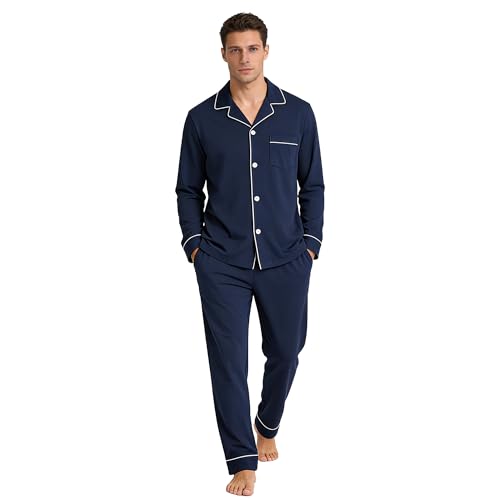 Cotton; construction not stated
U2SKIIN men’s 100% cotton button-down set
A complete button-down cotton outfit for men.
Check on AmazonContinue with the relevant guide
Back to Everyday decisions · Explore cotton pajamas
Sources and editorial method
This is a researched selection guide. We have not performed hands-on wear, washing or laboratory tests on the featured products.
- Tilly and the Buttons: Jaimie Pyjama Bottoms + Shorts
- Simplicity: Size Charts
- Tilly and the Buttons: Lotta Dress fabric requirements
- Seamwork: How to Match Plaids, Stripes, and Large Patterns
- Tilly and the Buttons: Jessa cutting, marking and preparing fabric
- Seamwork: How to download and print PDF patterns